Wednesday, 31 December 2014

Get On Up, the James Brown biopic , hits cinemas today. Forget about the music and politics for a second
 Chadwick Boseman as James brown in Get On Up Photograph: Allstar/UNIVERSAL PICTURES/Sportsphoto Ltd./Allstar
1. The quiff  James Brown, 1964, New York Photograph: Michael Ochs Archives
The afro became a symbol of his association with civil rights but the quiff looked amazing, too. Bruno Mars, not to mention Janelle Monae, are channeling Brown’s excellent quiff work more than 50 years on. Coiffed and full, rising from the centre of his forehead, it was truly a thing of beauty. No wonder, as Arbus’ picture attests, it needed a hairdresser on hand at all times.
2. The tie
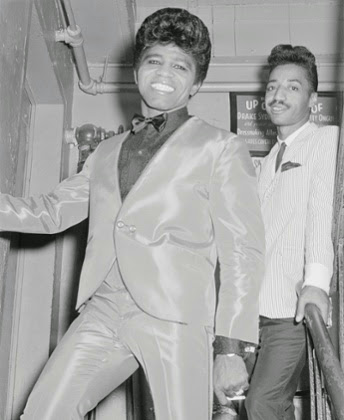 James Brown (Left) and Danny Rae Backstage at the Apollo Theater, 1964 Photograph: Michael Ochs Archives/Corbis
Brown went on to wear full-on jumpsuits, tracksuits, capes and flares but as befitting a man raised in Georgia, he started with the motifs of a Southern gentleman. The tie or bow tie is part of that look but works best when slightly skewed and pulled to the side after a trademark performance of blood, sweat and tears.
3. The short jacket
 James Brown, live on stage in 1964 Photograph: Chuck Stewart/Chuck Stewart/Redferns
Brown had performance uniform during this period, which the slightly short, boxy jacket was part of. Sometimes double-breasted, sometimes brocade, and always worn with a bright white shirt, the effect is razor sharp, all the better to take off and fling on the stage.
4. The skinny slacks
 L-R: Johnny Terry, Bobby Byrd, Bobby Bennett and James Brown Photograph: Michael Ochs Archives/Corbis
A James Brown performance is nothing without the godfather of soul dropping to his knees during Please, Please, Please. Who knows how he did this in trousers so tight they make American Apparel’s Disco Pantslook like Boyfriend jeans? Ours not to reason why. Marvel instead.
5. The pointy shoes
 James Brown performs at KCOP Studios on the Lloyd Thaxton Show in 1962 in Los Angeles, Photograph: Michael Ochs Archives
Another element of the Southern gentleman styling – smart shoes finish the look. They also, with thin slidy soles, work as a prop for dancing, as seen when Brown taught a bunch of teenagers to dance in 1962 or attempting to do the same with Tonight Show host Johnny Carson in 1967.
Theo22211Read more »

Tuesday, 9 December 2014

PORTLAND, Ore. — Today, white LEDs are not really white, but instead use techniques such as combining
The technique inserts platinum atoms inside the polymer interchain of an organic semiconductor, with different spacings allowing it to produce different colors of light. Their hope is to create a polymer with various spacings of platinum atoms, allowing them together to create white light from a single material.
Z. Valy Vardeny, University of Utah physicist, uses a glove box to handle light-emitting polymers under cleanroom conditions.
SOURCE: University of Utah
“We put the platinum atoms inside a polymer interchain using a synthetic process,” said University of Utah Professor Z. Valy Vardeny in a telephone interview with EE Times. “And we change the spacing between the platinum atoms to tune the color emitted.”
In addition, the platinum-rich polymers not only fluoresce, like R-G-B LEDs, but also phosphoresce like phosphor-coated LEDs, potentially making them much more energy efficient than traditional OLEDs.
“OLEDs today fluoresce, converting only about 25 percent of their energy into light, but our platinum-rich polymer is phosphorescent too, allowing us to recover come of the remaining 75 percent of electrical energy,” said Vardeny.
The next step for the researchers is to experiment with different spacings between the platinum atoms in the polymer interchain, as well as to experiment with other heavy molecules besides platinum. To date, the researchers have produced two materials — one with a platinum atoms between every link in the interchain — resulting in violet and yellow light, the other inserted a platinum atom between every third link, resulting in blue and orange light. The hope is that a polymer with various spacings between platinum atoms can produce all the wavelengths in white light.
“The ultimate goal is to create white light. Unfortunately, white light is very not well defined, but essentially we want to emit all colors,” said Vardeny.
The platinum-rich polymer today must be stimulated by light to work, but once the formula for a white-light polymer is defined, the researchers will fashion an OLED material out of it that emits in response to electrical stimulation. The researchers estimate about a year will be needed to perfect the white-light emitting polymer and another two to convert it into an OLED.
The researchers also plan to apply the technique to creating a new type of solar cell. And because platinum-rich polymers allow information to be stored on the spin of electrons, the material has the potential to create a new type of memory chip.
Get all the details in the free downloadfrom Scientific Reports.
Funding was provided by the US Department of Energy and the National Science Foundation, the National Natural Science Foundation of China, and China’s Fundamental Research Funds for the Central Universities. The research was conducted in cooperation with Los Alamos National Laboratory scientist Sergei Tretiak, University of Utah postdoctoral researcher Chuanxiang Sheng (now at Nanjing University of Science and Technology in China), and with University of Utah doctoral candidates Sanjeev Singh, Alessio Gambetta, Tomer Drori, and Minghong Tong. Chemist Leonard Wojcik synthesized the platinum-rich polymers.
Related posts:
Read more »