Saturday, 13 December 2014
We need more women like Olenka Frenkiel to speak publicly about what amounts to institutionalised discrimination
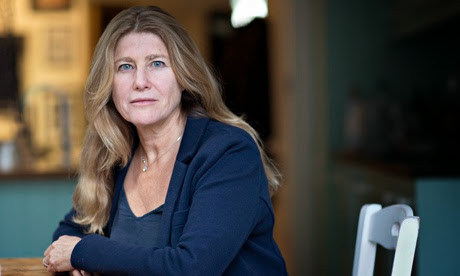 Former BBC reporter and documentary film-maker Olenka Frenkiel, whose experiences ‘provide yet another frustrating reminder of the dismissive way women are treated in broadcasting’. Photograph: Teri Pengilley
Although your editorial in the same edition focused mainly on ageism and older women “not looking the part” in our visual world (which of course is true), I suspect – as acknowledged by Penny Marshall ( Report, theguardian.com, 5 November) – that the real root of the problem lies in men keeping top jobs for themselves.
As a criminal barrister for over 20 years I have witnessed how women in my profession are too often sidelined as their careers progress. One of the most obvious ways this happens at the criminal bar is that senior women are increasingly instructed on sexual abuse cases (often to the exclusion of little else), while men get murders, lucrative frauds and many of the high-profile cases. I agree that the BBC has a special duty to lead the way on gender imbalance, and Tony Hall’s announcement that, by 2015, 50% of breakfast presenters on local radio should be women is a good first step. However, it does little to solve the problem of older women and top jobs.
Mary McKeone
Manchester
• Olenka Frenkiel’s experiences provide yet another frustrating reminder of the dismissive way women are treated in broadcasting. I have just written my third letter of complaint to the BBC over the last 18 months about the paucity of women panellists on Question Time. Last week, four out of the five panellists were male.
I was informed in response to my previous complaints that “programme contributors are appointed on the basis of their experience and talent”. Can they seriously expect us to believe that they continue to be unable to find enough sufficiently experienced and talented women to address this gender imbalance? Your editorial rightly emphasises the duty of the BBC to lead the way on gender equality in broadcasting. The BBC needs to recognise that the time for excuses is long past.
Dr Edie Friedman
London
• It is a sad fact that it is not just in journalism that older women are being pushed out. I am a 51-year-old primary school teacher now working as a supply teacher. Olenka Frenkiel talks of women being encouraged to sign a gagging clause and of not doing so herself ( Why I rejected gagging clause – BBC journalist, 8 November). Teaching unions give the impression that there is no choice but to be gagged. The unions seem to not be interested in the situation faced by older women. I go to many different schools now and rarely meet other teachers as old as myself. Older teachers are more expensive but we do not take maternity leave or time off with sick children. We are also more experienced.
Perhaps Olenka could undertake some research into the fate of older women. Could she start with the statistics for women leaving work with gagging clauses?
Mary Daykin
Chorley, Lancashire
• BBC, what are you thinking? As a licence payer I demand that you commission Simon Mayo and Mark Kermode forthwith ( Everybody thinks we’d be great on TV – apart from channel controllers, Media, 10 November). White, middle-class, middle-aged males with large protuberances of self-regard are clearly in short supply.
Karen Peploe
Berkhamsted, Hertfordshire

No comments: