Saturday, 6 December 2014

The Five Don’t of Affiliate Marketing For Bloggers
If you need extra income, you should consider doing affiliate marketing…
Monetizing a blog can be difficult, especially when you’re just starting out. How can you tell what your readers actually want?
This was my greatest challenge when I launched my blog.
Prior to the launch of my blog, I had read several e-books and posts – and the authors advised that I monetize my blog with affiliate offers.
As a newbie, I followed the laid out rules. I even filled my sidebar with affiliate banners and started blogging.
Day in and day out, I’d log into my clickbank account, hoping to see $50 – $100 in sales but nothing happened.
I was fed up and decided to take a better more logical approach. It was when I started promoting health affiliate products.
If this sad story sounds familiar, hang on and I’ll show you the 5 things you must NEVER do when promoting any affiliate product. It worked for me and I’m sure your own case will not be different.
1. Don’t use hype
I made a terrible mistake when I first started my affiliate business. Of course I didn’t know the negative effect of using hype at the time, but I was using it nonetheless.
If all you do is exaggerate the benefits of a particular offer, without considering your ideal customers’ interest, you’ll lose the trust they have for you.
Hype is an ugly marketing trick. Have you ever felt unhappy when the so-called gurus tried to exploit you? Making money as an affiliate marketer calls for honesty and integrity. Potential customers are counting on you to show them the way.
Don’t disappoint them with your hype and dishonesty. The bottom line is to promote only offers that are truly helpful. If there is any part of the module that isn’t so good, make it known to your readers.
3> 2. Don’t try to sell
Does this sound weird? After all, as affiliates we’re supposed to sell in order to make commissions. All right, I understand you perfectly, but there is a clause there.
The truth is that affiliate marketers are not supposed to sell anything. In fact, it’s not their primary duty.
The role of an affiliate marketer is to motivate, inform and educate potential buyers. If you try to sell the offer, when you eventually lead the prospects through to the salesletter, converting them would be difficult.
Instead, presell in an honest manner and creatively lead the person to the store to complete the sale. Use valuable content to teach people what to do. Teaching sells so well online – use it.
That’s how to pre-sell. Share your best information and don’t hoard any no matter what happens.
3. Don’t hard sell your subscribers
I know a lot of affiliate marketers who send new products every week to their subscribers. This can be irritating and I advise you don’t do it.
The email list is a vital component of your blogging business. You should nurture your subscribers and get them to trust you.
Once you can achieve that, it’d be a lot easier to monetize the list and make more money.
Bear in mind that sending an affiliate offer that you know would be helpful to your list isn’t a bad thing. In fact, it’s one of the reasons why you should collect leads in the first place.
What I’m saying is that you should minimize promotional email blasts. Balance the free information you share with premium offers. That’s how to build a reputation online, which money can’t buy.
4. Don’t stuff your blog with banners
The sidebar is a viable spot to add affiliate banners. But don’t overdo things and confuse your readers.
You’ve got to understand that people came to your blog because they’ve got needs in their lives. Every day, millions of people search the web, looking for answers…
Quality content is the only answer you should provide. Yes, with quality content you could easily recommend a helpful affiliate product and make money too.
If you do place advertisements on your sidebar, there is no need to have more than four banners of your favorite affiliate products – keep the sidebar clean.
Preferably, promote offers you currently use to run your business, or promote products you would try yourself. It’s the easiest way to persuade readers to purchase and share with others.
And when they buy through your link, you’ll earn a commission and who knows how much that’s going to be.
What do you say?
What are you waiting for to start making money via affiliate marketing? Remember, bloggers who don’t make enough money from this profitable business model don’t have the required knowledge to make it work.
What you need to get started is an affiliate marketing coachthat knows what works, and knows how to take baby steps to achieve your internet marketing objective. Leave a comment below if you enjoyed this post. Thank you for reading…
Read more »

Friday, 28 November 2014

Steve Jobs’ Former Ad Chief Says Apple’s Marketing Has Become ‘Soft’ And ‘Ordinary’
 Ken Segall Former Apple Agency Exec Ken Segall.
Ken Segall says Apple’s advertising has become “soft” and “ordinary.” Those are harsh words — Segall worked alongside Steve Jobs at Apple in the 1990s in his role as creative director at advertising agency TBWA/Chiat/Day. He put together some of Apple’s most iconic campaigns, including the “Think Different” effort that was credited with turning Apple’s corporate image around. And he named the iMac (Jobs had originally wanted to call it the “MacMan,” but Segall persuaded him otherwise).
In recent years, however, Apple’s advertising hasn’t been that great. Its most memorable recent campaigns were the longrunning “Mac vs PC” ads and its dancing silhouette work for the iPod. Both those campaigns ended years ago. Since then, Apple’s ads have mostly shown its products against a white background, along with a catchy song. (There has been some generic corporate image work, too.) They may have been effective in helping launch the iPhone, but it’s been years since Apple put out a really defining campaign that matches up to the Jobs era, according to Segall.
In fact, he says Apple’s advertising has become “kind of soft.”
We spoke to Segall about where he thinks Apple has been going wrong of late and how the company can get back to its legendary marketing days of old. Below is our lightly edited Q&A:
Business Insider: What do you think of some of Apple’s most recent non-product advertising campaigns, like the “Designed by Apple in California” push, which it launched in 2013 but hasn’t repeated since. Does that show a lack of marketing confidence from the brand?
Ken Segall: Apple is so over-analyzed: People put so much importance in different things that may not have importance [to the company’s bottom line], like some of the content of the ads in the last couple of years. But what people fail to realize is that some of these campaigns have happened when Apple has had nothing to say. That’s when things like “Designed By Apple In California” came along and softer ads like [the campaign for] people using the iPad. They did not have much edge.
My current example of this kind of “ordinary” ad would be the “Your Verse” campaign. It felt very much like a “big company” campaign, in effect just saying that people all over the world are doing amazing things with the iPad — but they’re also doing amazing things with Samsung tablets. This campaign didn’t give iPad a personality, nor did it have any kind of Apple-esque edge to it. It’s the kind of advertising that makes current iPad owners feel proud, but does little to attract new customers or generate any buzz.
BI: And what about recent campaigns when Apple has had something to say, like for the new iPhone 6 and iPhone 6 Plus?
KS: The last couple of years have been kind of soft. The Timberlake and Fallon iPhone ads, there’s a whole lot you could criticize about those ads. The obvious comparison would be that it was in the spirit of the “I’m a Mac” campaigns.
But it was not quite as legendary and great. It wasn’t an “us versus them” so that edge Apple had has got a bit rusty. The [iPhone 6 and 6 Plus] ads just were not as funny as they could have been. And also you have two famous people starring in them, but most of the world did not know who was talking. It was very anonymous.
I think they are OK ads, not amazing.
BI: Who’s to blame for the apparent lack of edge?
KS: The popular story is that Apple is taking most of its advertising in-house as the agency people are not getting along with [Apple SVP of worldwide marketing Philip] Schiller.
When your client is not enthralled with you, you tend to treat advertising with more care and with the concern of not rocking the boat too much.
I like to believe the [Apple’s advertising agency] TBWA crowd does have a creative backbone … but business is business. If the relationship with Schiller is strained, that does effect the work you’re doing. I would love to be a fly on the wall!
There was that classic moment during the Olympics when Apple launched those Apple Genius ads.Those ads were awful by any measure, with all kinds of cat calls to competitors and I just have no idea how a campaign like that could even come out of Apple. I’d like to know who pushed for that.
BI: Has the relationship always been so strained between Apple and its ad agency?
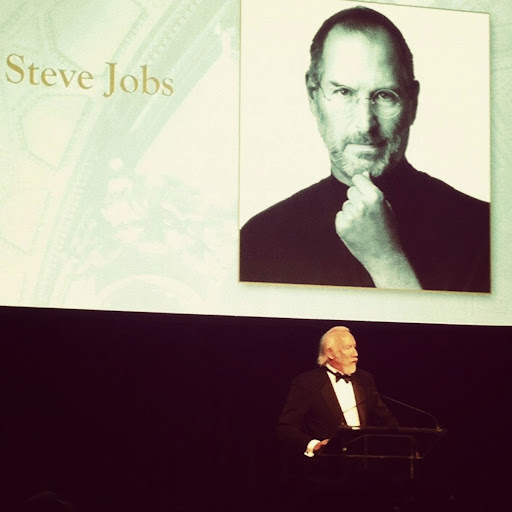 TBWA Lee Clow KS: TBWA and Apple had a great relationship. With Lee Clow [now chairman and global director of TBWA\Worldwide and previously TBWA chief creative officer] on the agency side and Steve Jobs effectively as the client. But both of those are no longer around [Clow is now TBWA’s chairman.]
Steve had confidence in his relationship with the agency. He would say, outright, “this is crap” or “this is great” and you could debate. And sometimes we won those debates, although he was always opinionated.
Most other people in advertising don’t have that confidence. They look for a second opinion. Most people will hold up a good idea to a list of points they want the advert to make. That’s not the way it would have ever worked with Steve.
We would come in with a great idea and he would say “I love this!” and forget what the ad was originally set out to do. He trusted in the great idea.
That confidence in marketing may not be there now. There seems to be that need to get more people behind the idea before it goes forward; that’s why you’ve started seeing more calls to action [in ads] and more campaigns.
That may be one reason why Apple’s advertising became a bit more ordinary without Steve.
BI: Do you think Apple is also looking over its shoulder more at the rise of Samsung in the smartphone market?
KS: Some of the recent Samsung adshave done what Apple did to Microsoft in the “I’m a Mac” campaigns. But often they can really be a dud, too.
They spend three to four times as much on advertising than Apple. And Apple are up against this perception that they’re failing to innovate and that Samsung is the true innovator, so you could say it’s been a perfect storm. But now even Samsung has had quarters of declining sales.
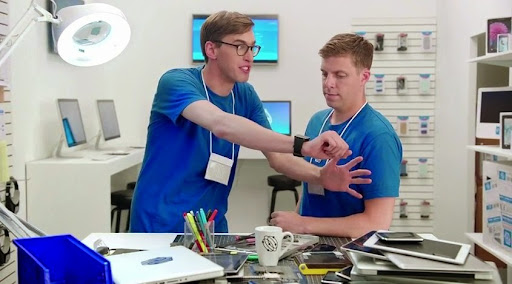 Samsung One of Samsung’s recent ads, parodying Apple’s “Geniuses.”
BI: But even still, some people could say Apple has been taking tips from Samsung and other competitors, with its bigger screens and entering the wearables category after others did…
KS: Apple screens are at last as big as others and people are flocking back as a result. The watch is really interesting because people asked the “what would Steve Jobs have done” question; they say that he would never have created a product with so many versions, that he would have just done one killer model. But when Steve passed away it was that beginning of a new era for Apple.
A good analogy is Walt Disney, when he died the company focused itself and rose up in a way he might not have ever imagined. That’s perhaps true of Apple as well, although I did not expect it to happen so soon. But Steve Jobs might not have imagined the world we are in now and that these products need to be done differently.
BI: How should Apple advertise the Watch when it goes on sale next year?
 Business Insider The Apple Watch, of which there are many different versions. It should be object-of-lust advertising. If you look at the outdoor ads Apple has done for the iPhone, it’s just the phone, “Here’s the iPhone 5C.” In the old days they would have included some clever copy but I think it’ll very much be “Here’s the Watch.” That brief.
With the Watch that will probably be enough because there will be so much buzz around it they won’t need to say “here’s how it works.” The TV can be more explanatory if needed.
Apple do dabble with celebrities and there’s been some conjecture that they are lining up a big model to be their spokesperson. But I find that really surprising.
Like the iPhone, there will be such an incredible buzz that they really don’t need to have a whole lot more saying “look how gorgeous this is”. Word of mouth, at no cost, will do the talking for them.
BI: Steve Jobs was a huge personality at Apple. Is there a need for Apple’s top execs to have higher personal profiles now?
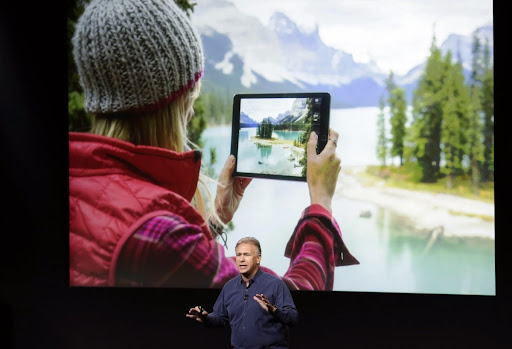 AP Apple SVP of worldwide marketing Philip Schiller on stage. KS: Part of the Apple core is that they do have interesting people. Tim Cook has done a reasonable job of becoming the official voice of Apple, but I don’t know if the public see him as that, not as much as they did Steve Jobs.
Phil Schiller is a really smart man and he can be very entertaining and spontaneous. His interactions with Steve at keynotes of the past were some of my favorite moments. He is a terrific product guy, but he doesn’t have the level of taste or marketing savvy that Steve had. Perhaps that’s an unfair comparison. because Steve rated off the charts in both of those areas — but in his current position, that’s the comparison people make. And, despite his brains and sense of humor, he’s a bit lacking in charisma department.
Craig Federighi [Apple’s SVP of software] has done a good job, people seem to be impressed with his on-stage demonstrations. But it’s surprising that Jony Ive [SVP of design] doesn’t do the demonstrations, it does not seem like he has that kind of confidence.
BI: What’s your favorite Apple advertising push you worked on?
KS: That would have to be the “Think Different” campaign, which stands out in Apple history because it was a pure brand campaign. We never showed a single Apple product in it. This was the first campaign we did when Steve returned to Apple, and its purpose was to simply tell the world that the spirit of Apple was alive and well and to set the stage for the revolutionary products to come. By the way, we had no clue what those products would be, but we took Steve’s word that amazing things were to come.
The idea of the campaign was simple: we would celebrate the lives of people who changed the world. And when you tell the world what kind of person you admire, it says a lot about you.
TheoBusinessinsider comRead more »