Monday, 8 December 2014

The Guardian’s planned new events venue is a 2,800m 2 space that forms part of a redevelopment of the
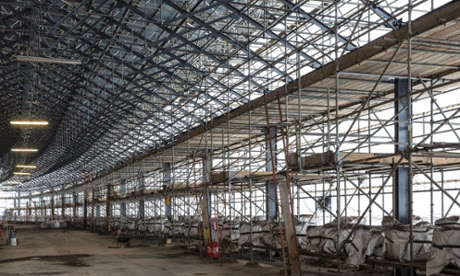 The interior of the construction site at the Midland Goods Shed, in King’s Cross. Photograph: John Sturrock
Our design takes advantage of the grand, cavernous spaces provided by the original architecture of the Midland Goods Shed and the lofty height of the East Handyside Canopy. The nature and mix of uses, together with the design solutions to accommodate them, allows the public to experience the dramatic spaces within for the very first time and creates an innovative new focal point for King’s Cross.
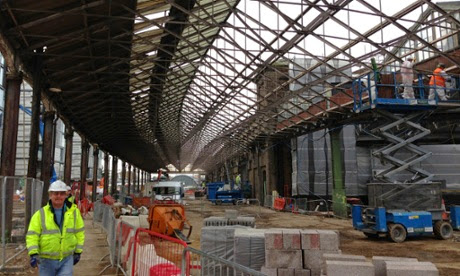 Work in progress: the Midland Goods Shed construction site. Photograph: Jonathan Robinson/Guardian
Built by the Great Northern Railway in 1850, the Midland Goods Shed originally served as part of a temporary passenger terminal while the current King’s Cross station was being built. It was converted to a goods shed for the Midland Railway in 1857 and used for the handling and storage of goods that were brought into King’s Cross from across the country. The East and West Handyside Canopies were added in 1888, to provide a covered space for the transfer of potatoes and other perishable goods from rail to horse and cart.
Our design reconnects with the area’s industrial past. The mainline railways radically changed King’s Cross, with their extensive goods yards, built close to the canal for interchange purposes. Many of the industrial buildings and structures are fine examples of industrial brickwork that demonstrate styles of engineering and construction characteristic of the 19th and early 20th centuries, with the use of various types of brick, along with cast and wrought iron.
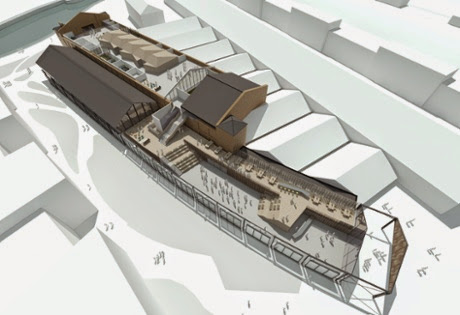 The axonometric plan for the Guardian’s space in the Midland Goods Shed. Photograph: Bennetts Associates
The design of the new space preserves the shed’s varied and idiosyncratic Victorian character of robust brickwork, thundering cast iron structures, cavernous spaces, delicate roof trusses and the majestic sweep of the 130m-long East Handyside Canopy.
A dominant feature of the structure is the 1878 ballast tank in the accumulator tower, which has been retained and lifted up, freeing up the ground floor area to serve as a lift lobby.
To maintain the character of the building, more recent additions to the structure, such as the steel trusses which date from 1957, have been replaced (in this case with new splayed steel scissor trusses designed in the spirit of the originals, with an intricate play of geometries).
This imaginative and flexible events space will link with the presence of neighbouring and pan-London arts and media organisations, and will hopefully become an extraordinary focus point for curiosity, conviviality and learning.
Interested in the future of the Midland Goods Shed? Keep an eye out for updates on the development here. Theo22211
Read more »

Monday, 1 December 2014

Festivities of Natural Annual Events: Borealis Transequilux (Midway Global Solstice & Equinox)
F.N.A.E. articles are written with Ehoah phrases
What is Seasonally Occurring
During this transition between the Solstice and Equinox the earth’s orientation is now angled with the southern hemisphere(Australis) getting less sunlight while the northern hemisphere(Borealis) is now getting more. In Borealis the days are getting longer, seeing the earth’s daily turning view of the sun higher along the southern horizon; for Australis the days are getting shorter with the daily turning view of the sun becoming lower along the north horizon; The equatorial regions will be seeing the daily turning view of the sun closer to the center of the sky from the south.
Within the Australis Polus Axis the turning horizon is closer to the sun’s disk with shorter days, and within the Borealis Polus Axis the turning horizon is getting further below the sun’s disk.
For Australis it is the hottest time of year and the wettest for many regions. Most of the warmer regions would now be experiencing their harvest and/or preparing for a “winter growing season” that is better adapted to colder temperatures and less daylight. Some species begin their migrations north.
For the Tropics, this is when the Tropical Rain Belt is almost at is most southern point in the year.
South of the Borealis Polus Axis, excluding West and Southern Europe (because of the warm ocean currents in that region of the world), it is the deepest of winter being the coldest time of the year. Around the Borealis Sol Axis, with the addition of Southern & Western Europe, spring is coming into effect with sprouts and flowers becoming visible.
Seasonal Customs
South of the Borealis Polus Axis, with the exclusion of South and Western Europe, a great many communities are hosting winter festivals for this coldest time of year, including activities of snow sculpting, ice fishing, ice skating, sledding, dog sledding, horse/reindeer pulled sleighs, skijoring (dog team, horses, or reindeer pulling a skier) and so on before the snow melts in the following months.
For the warmer climes of Borealis, there is more focus on the coming warmth and light of summer, banishing the dark, cleansing (ritually with fire or through diet or with thorough housecleaning) and celebrating the beginning of spring. Many regions celebrate with brilliant colours, a healthy dose of mischievousness and youthful gaiety in the excitement of spring. As the night still comes early for both climes, there are usually fireworks, bonfires and light displays during or marking the beginning or ending of the festivities. Because of the noticeable increase in day length many cultures have their new year begin around this time.
In Australis, various regions are having the summer harvest coming in and the winter planting season soon beginning.
BOREALIS
AUSTRALIS
If anyone knows of other celebrations and festivities that reflect the current season that are not in the chart, please post them below – they will also be put in next year’s post.
Theo22311Read more »