Monday, 8 December 2014

Yes it is royal wedding time, once again (at least for those of us old enough to remember Charles and
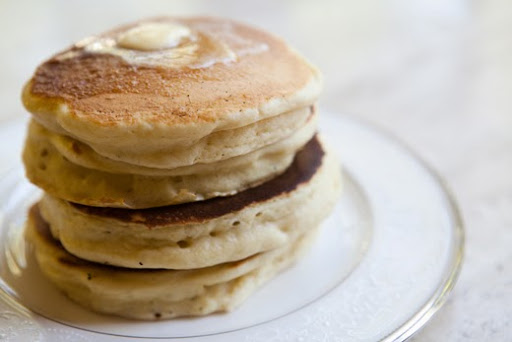
When I first started testing this recipe, I couldn’t understand why the dough was more of a pancake batter, and not “scone-like” as I had imagined. Here in the states we think of drop scones like drop biscuits, instead of cutting out triangular shape scones for baking, we drop the dough from a spoon onto the baking pan. But “drop scones” in parts of the UK, in particular Scotland, where Balmoral castleis situated, are more like American pancakes than typical scones. Drop scones are thicker than American pancakes, and a little smaller.
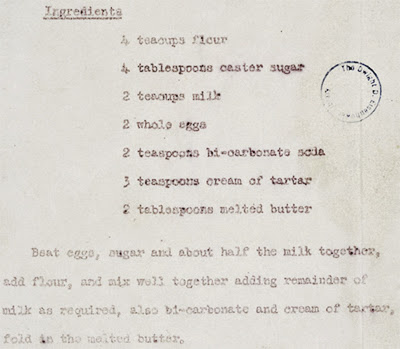
If you read the Queen’s recipe in the image above, note the use of “teacups” as measurements for flour and milk. Before Fanny Farmerwe used teacups for measures as well. To figure out how much a typical teacup holds, I tested two teacups, an English made one, and a French limoge. Oddly, when I filled each (completely different shape) tea cup with flour and weighed them, the result for each was exactly 100 grams. By volume, the teacups were each 3/4 of an American standard cup. So “4 teacups” would be 3 American cups, and “2 teacups” would be 1 1/2 cups.
European butter has a much higher fat content than standard American butter, so if you have European butter, you may want to use it, to more closely replicate what the Queen was making. Most recipes for drop scones I found add a little salt. I don’t know if the Queen used salted butter or not. Her recipe doesn’t call for it, but since I use unsalted butter, I added a little salt to the batter.
A note on the cream of tartar. We happen to have some in our pantry, but many people don’t. Cream of tartar is a dry acid. It combines with the alkaline baking soda to create the leavening in the scones. Baking powder is just the combination of baking soda and cream of tartar with some corn starch thrown in, so if you don’t have cream of tartar, you can substitute both the baking soda and the cream of tartar with baking powder.
Congrats William and Kate!
Queen Elizabeth’s Drop Scones Recipe
Prep time: 10 minutes Cook time: 15 minutes Yield: Makes about 16 American-sized pancakes.
I’ve changed the method just a little from the Queen’s original, by adding the wet ingredients to the dry, instead of the dry to the wet.
Ingredients 3 cups (400 g) all-purpose flour 2 teaspoons baking soda* 3 teaspoons cream of tartar* 1/4 teaspoon salt** 2 eggs 1/4 cup of superfine sugar, or a heaping 1/4 cup white, granulated sugar 1 1/2 cup (350 ml) of whole milk (and maybe a little more if needed) 2 tablespoons butter, melted
*If you don’t have cream of tartar, substitute the 2 teaspoons of baking soda and the 3 teaspoons of cream of tartar with 5 teaspoons of baking powder (make sure your baking powder is less than 6 months old or it may be flat and unable to provide leavening).
**If using salted butter, skip the added salt.
Method
1 Whisk together the flour, baking soda, cream of tartar, and salt in a large bowl.
2 In a separate medium sized bowl, whisk together the eggs and sugar. Then whisk in most of the milk.
3 Make a well in the middle of the flour and pour in the milk egg mixture. Whisk until smooth, adding more milk until you get the right consistency – thin enough to spread on the pan, but not so thin as to run. Fold in the melted butter.
4 Heat a griddle or large cast iron pan on medium to medium low heat. Coat the pan with a little butter, spreading it with a folded over paper towel. Drop large spoonfuls of batter on the griddle to form pancakes. When bubbles start to appear on the surface (after 2 to 3 minutes), use a metal spatula to flip the pancakes over. Cook for another minute, until lightly browned. Remove to a plate and cover with a clean tea towel to keep warm while you cook the rest of the drop scones.
Serve with butter, jam, or golden syrup (Americans sub maple syrup).
Hello! All photos and content are copyright protected. Please do not use our photos without prior written permission. If you wish to republish this recipe, please rewrite the recipe in your own unique words and link back to the source recipe here on Simply Recipes. Thank you!
An extra note here, when I first started playing with the recipe, I didn’t realize it was for what are essentially pancakes. I was expecting more traditional scones, and therefore kept working at the recipe until I got them. I did manage to pull a more traditional scone out of the Queen’s recipe, just by doing a couple of things. I reduced the milk to one cup. I mixed the ingredients until they just came together as a sticky, shaggy dough. I used heaping tablespoons of European butter. With this mixture you can make drop biscuits. Just measure out 1/4 cup scoops of the dough onto a parchment-lined baking sheet and bake at 400°F for 12-14 minutes, until nicely browned on top. Serve warm with butter and jam.
Links:
National Archives Features Royal Wedding Breakfast Recipe
Scottish drop pancakes videofrom Maw Broon’s Cookbooks editor, Eleanor Abraham
Drop sconesfrom Nostalgic Recipes from Nice
Drop scones with berry compotefrom Inside Cuisine
Wikipedia on pancakes, including Scotch pancakes
Read more »

Tuesday, 25 November 2014

Being a Mom (or Dad) is More Than Enough
A few years ago I read an essay by a woman arguing that feminism did a major disservice to families by teaching women to evaluate their own worth by the same measures which men use to evaluate themselves. She argued that the movement adopted the typical American man’s view of self-worth which says a person is only “worth” the economic capital he or she produces. Consequently, she argued, women delegated the raising of their children (which in itself makes no money) to other people. In some cases they even decided to forgo bearing children altogether in exchange for a pursuit of professional advancement. It was a thought-provoking essay written by a woman arguing for the traditional patriarchal division of gender roles and identities. As such, I now find myself in disagreement with several things she said, but I’m not sure she’s entirely wrong about everything she said. I do think something was lost during the heyday of the feminist movement. Her primary mistake, in my opinion, was in applying this only to women.
To my mind, the real problem here wasn’t that women decided they could succeed at occupations previously dominated by men. The truth is that they very well can and do, often surpassing their male competition through a shrewd combination of decisive judgment and open-minded sensitivity. The problem was that now both men and women learned to devalue the work that homemakers do simply because in itself it doesn’t generate income. In other words, if I have a complaint with some factions of the feminist movement (particularly from the early days), it is the same criticism that I have for the rest of my culture: Many of them adopted the materialistic, consumer-driven mentality which says that a person’s worth is determined by what he or she buys and sells. For this reason, the man or woman who decides to “stay at home” in order to devote his or her time and energy into raising children must fight feelings of inferiority, as if the work they have chosen for themselves isn’t legitimate “work” at all. But I am convinced that many of the most valuable things that people do yield intangible and unquantifiable benefits to themselves, to their families, and even to society in general.
If you purchase Pixar’s movie The Incredibles (one of my all-time favorite flicks), you will find among their deleted scenes an unfinished alternate opening which features Helen Parr (aka “Elastigirl”) going off on a party guest who blatantly dissed homemakers for their decision to stay home with the kids. Helen’s retort is poignant and passionate, and I wish they had included it in the film. If you haven’t seen it, I found a clip of it here:
Incidentally, I wonder what salaries would look like if people were paid according to the “big picture” value of their work? I wonder who would have the largest salaries? Would it be the guy who does facelifts and botox injections? Or would it be the girl who counsels abused children, teaching them to trust adults again? Would it be the guy who defends hedge fund managers or pharmaceutical executives from lawsuits? Or would it be the woman who taught the lawyer how to spell the word “law”? Whenever the subject of teacher salaries comes up (Disclosure: I are one), I am often told that the reason my annual earnings are as little as one tenth of what the plastic surgeon makes is because it’s harder to become one of those (Question: Is it ten times harder?). They tell me anybody can become a teacher, and for that reason it pays far less. Supply and demand, they say. I understand just enough about economics to know there is some truth to that, but I don’t think that’s the whole picture. I think ultimately once all the factors are pulled together, there’s an additional element that is being overlooked. A society will reward most those who do the work it values most. In a capitalistic culture where consumerism rules, those people who do the most to stimulate the economy are the most heavily remunerated. And I mean in more than just words.
Take teachers again, for example. People love to offer verbal praise for what teachers do. “Oh, I think what you do is just wonderful ,” they say, or “I could never do what you do; I just have the highest respect for teachers!” It’s particularly pronounced if you teach students with special needs as I did for several years. People would almost gush when I told them what I did for a living. “Awww!” they would say, “That’s so great!” (Note: Two moments a guy doesn’t want to hear “Awww!” are on his wedding night and when he tells someone what he does for a living). Other times they say: “I really admire you folks for doing what you do!” This is all well and good, but it doesn’t change the fact that our compensation is comparatively less than what it was 40 years ago (adjusted for inflation) so that most of us require second and third jobs to make up for what’s lacking. For all the value my culture says it places on the work I do, the paycheck tells a different story.
But where does that leave homemakers? What about the stay-at-home mom or dad? (“Stay at home” is a complete misnomer, by the way, in case you’ve ever been one) What value do we place on their work raising children, teaching them to do almost everything they will learn to do as they grow up? Obviously they don’t get paid salaries for what they do, but why not some other form of financial assistance? It seems like a civilization which highly values parenting would find ways to provide some kind of assistance to those who do its most important work. And what could be more important than what mothers and fathers do? Just like we do with teachers, I think we pay lipservice to the importance of parenting but then turn around and do other things which reveal a terrible undervaluation of the job.
I guess this topic is fresh on my mind lately for a couple of reasons. One is that the other day a friend posted a link to a great blog pieceby Rachel Martin which beautifully describes why “being a mom is enough.” In fact it’s more than enough , but I presume her modest word choice simply exhibits that she shares my fondness for understatement (Question: Why don’t we call that hypobole?). The second reason this topic is near to my heart at present is the same reason I haven’t been able to write anything in nearly a fortnight: I’ve been too busy trying to juggle work and caring for children, whether my own or someone else’s. In fact, most of my jobs relate to caring for someone’s children, and when I’m not doing that, I’m caring for my own. Few things demand more from a person emotionally, mentally, or at times even physically than caring for children. But people who don’t devote much time to that have no concept of how demanding this really is, especially if they aim to do it well . They may say it’s valuable or noble, but then they turn around and do things that show they didn’t really mean it.
What I’m saying is that parenting—particularly full-time parenting—is indeed enough. It’s more than enough . In my opinion, it’s far more valuable than most jobs out there because what you do for children when you devote the best of your time and resources to caring for them accomplishes things in their little minds and hearts that nothing and no one else ever could. Teachers can’t do for kids what a mom or dad can do. Doctors can’t, either, or lawyers, or politicians, or law enforcement officers, or social workers, or anyone else with whom they come in contact. Children are wet cement, they say, particularly in the first few years of life. Therefore, what work matters more in the formation of people than the early years in which parents play the chief role in guiding, teaching, and caring for them?
Fortunately, unlike cement, children are highly resilient. They can overcome many of the mistakes we make in raising them. Some of the most well-adjusted adults seem to have come from some incredibly dysfunctional backgrounds. It’s one of the cool things about being a sentient life form–we can often make the best out of the most horrific circumstances. But those children with the most advantages probably had someone decide that caring for them was worth sacrificing some things in order to give them the best upbringing possible under the circumstances.
Not everyone can afford to do this, of course. Someone has to make a living, and not everyone can figure out a way to make enough money working from home (especially if he or she is doing it solo) while still remaining available as primary caregiver to someone else (or multiple someones). You do what you can. I also want to reiterate that I disagree with those who insist it must be women who do this, as if ancient patriarchal societies are normative for all generations. But if you happen to be one of the men or women who find a way to make being a homemaker their primary task, in my opinion you have picked a job that ranks among the top tier professions imaginable, regardless of the lack of compensation. No one else can so powerfully and effectively shape future persons as you can. Like the character in the clip above, you should be proud of the work you do because it contributes far more to society than litigation or rhinoplasty ever will. It’s more than enough.
Theo22311Read more »